How to find a software idea and build a product that sells $200K+ a year
The 6-phase process to figure out which software is worth building, how many customers you need and at what price, before you write a single line.
Playbook 01 · PDF · Spanish and English · one-time payment
6
phases
6
templates
10
interviews
83
customers
9 out of 10 startups fail. Not for lack of drive.
They fail for lack of method: they build something nobody needed.
You have the technical skills. The problem is something else: you don't know what to build. Or worse: you already built it, it works perfectly, and nobody uses it.
And when you look for help, you get "find a problem you're passionate about and solve it." That isn't a method. It's a poster quote.
From 483 post-mortems analyzed by CB Insights. And the detail almost nobody looks at: "ran out of money" is the symptom, "no market need" is the cause. Nobody runs out of money building something people pay for.
42%
had no market need
29%
ran out of money
23%
had the wrong team
This is how you build a startup from scratch.
The principle Y Combinator works by, now in your hands: first the customer who pays, then the product.
It isn't a "find your passion" course, a list of 100 SaaS ideas, or a sticky-note framework.
And it starts in the most uncomfortable place: the math. Who pays $200 a month? Not an entrepreneur who is just starting out. A company with a process that costs it money, that already tried to fix it and couldn't.
The math
What you do in each of the 6 phases.
By the end of phase 2 you know whether your idea works. Not in month eighteen: in week four.
- 0
The thesis
1 hour
You learn to tell a vitamin from a painkiller, and why you start narrow.
- 1
The number
1 week
You close the math: price point, customer count, chosen industry and a market sized from the bottom up.
- 2
The problem
2 to 3 weeks
You map the industry's processes and confirm or rule out your hypothesis in 10 interviews.
- 3
The solution
4 to 8 weeks
You build a beta that solves ONE thing and put it in the hands of 3 design partners.
- 4
Message and brand
1 month, in parallel
You write the differentiator your competitor couldn't claim.
- 5
Selling
ongoing
You pick ONE channel, write the discovery pitch and turn the 83 customers into weekly activity.
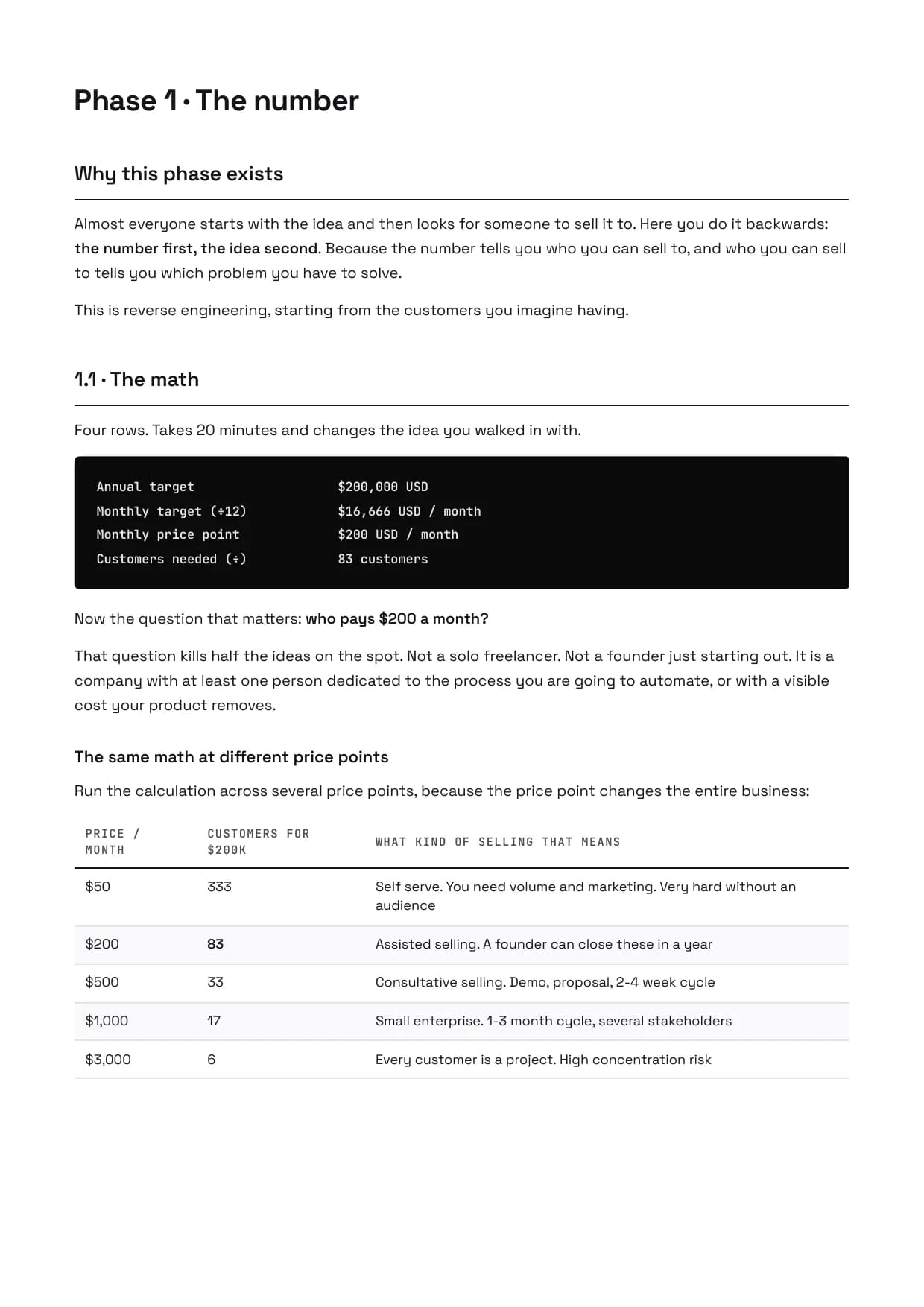
Read a page before you buy.
Our favorite page, in full. If it helps you, the rest is like this.
Free, no email needed
The math that drives everything else.
This is how phase 1 starts: how many customers you need, at what price point, and who you can sell to. That number picks the idea, not the other way around.
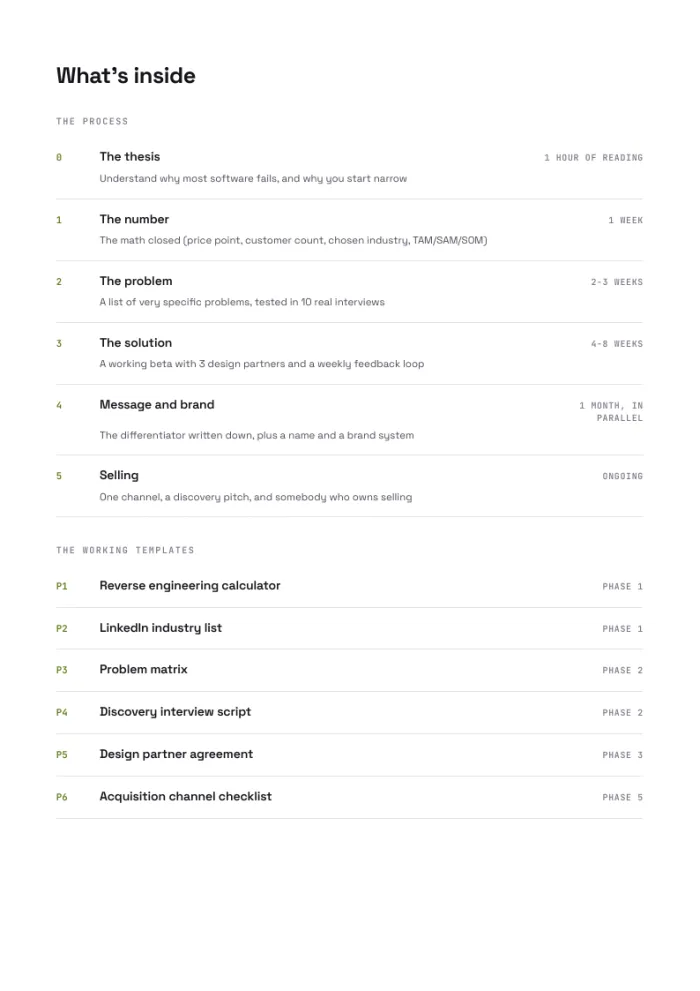
The playbook and 6 working templates.
The 6-phase playbook
With the deliverable, the time and the documented mistakes of each phase.
Reverse engineering calculator
From $200K to the exact number of customers, with price point scenarios.
LinkedIn industry list
The 20 sectors and the 6 criteria to pick yours.
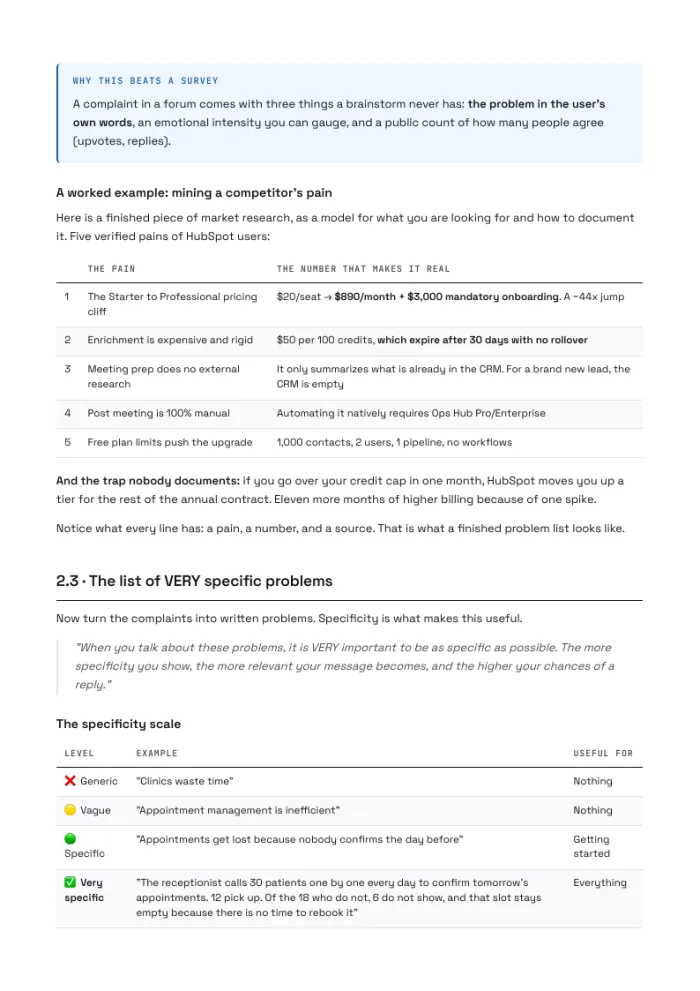
Problem matrix
From process to complaint to specific problem, scored on 3 axes.
Discovery interview script
The 16 questions in 5 blocks, and the 7 you should never ask.
Design partner agreement
One page, ready to sign, with the clause that makes the feedback actually arrive.
Acquisition channel checklist
The assets per channel, the weekly routine and the math worked backward.
Access to the Slack community
Where we are, along with everyone else putting it into practice.
Who it's for.
It's for you if
- You're technical, or you have a technical cofounder: you can build, you just don't know what.
- You already have an idea and want to know if it holds up before sinking six months into it.
- You already built something, nobody uses it, and you want to understand why.
- You're a freelancer or consultant and want to turn your service into a product.
It's not for you if
- Your business is B2C. You sell to people, not companies. The method assumes a company with a budget and a process.
- You want to raise a round. This is about revenue, not valuation.
- You're looking for an idea that doesn't require selling. The whole method assumes you'll talk to people.
- You already have paying customers and want to scale. That's playbook 02.
You won't find anything made up with AI.
The numbers from a real operation, including what went wrong.
The features we had to roll back
A technically superior variable syntax, scrapped after one line on a call: "I have a hard time seeing the kids using all of this." The lessons are in phase 3, and asking first would have avoided them.
The product we left in planning on purpose
A 1,900-line CLI was already running three clients. The platform meant to replace it went months without being written, because the manual process kept working better. Knowing when NOT to build is half of phase 3.
The positioning that won
Same product, two framings: the elegant one ("CRM-agnostic") and the one that sells ("the 5 things HubSpot charges you $890 a month to do"). The second one won, and phase 4 explains why.
The guarantee
If it doesn't add value, we refund your money.
Valid for every playbook, for 7 days from purchase. Email us and we refund the USD 29.
What to know before you buy.
Does it work if I have no idea what to build yet?
It's the case it was written for. Phase 1 doesn't start with the idea: it starts with the number, and the number tells you who you can sell to.
Does it work if I already built a product?
Yes, and it's probably the most urgent case. Run phase 2 on what you already built: in three weeks you know whether the problem exists.
Do I need to know how to code?
Not for phases 0 to 2, which are the ones that decide. Yes for phase 3, either you or a cofounder.
How long does it take?
Phases 0 to 2 take 3 to 4 weeks. The full process, up to having design partners, takes 3 to 5 months.
Why $200,000 and not a million?
Because it's 83 customers at $200 a month, reachable in twelve months by one person doing the selling. A million needs a sales team.
What is the Slack community?
Your purchase gets you into the Slack where we are, along with everyone else applying the playbooks. You ask questions, show what you built and see what others build.
Your idea, validated in three weeks instead of eighteen months
Both options cost money. One costs USD 29.