How to do outbound?
The manual for the channel we run every day: your first outbound campaign over email and LinkedIn sending in 3 to 4 weeks, with the math done on how many meetings to expect and without burning your company domain.
Playbook 06 · PDF · Spanish only · one-time payment
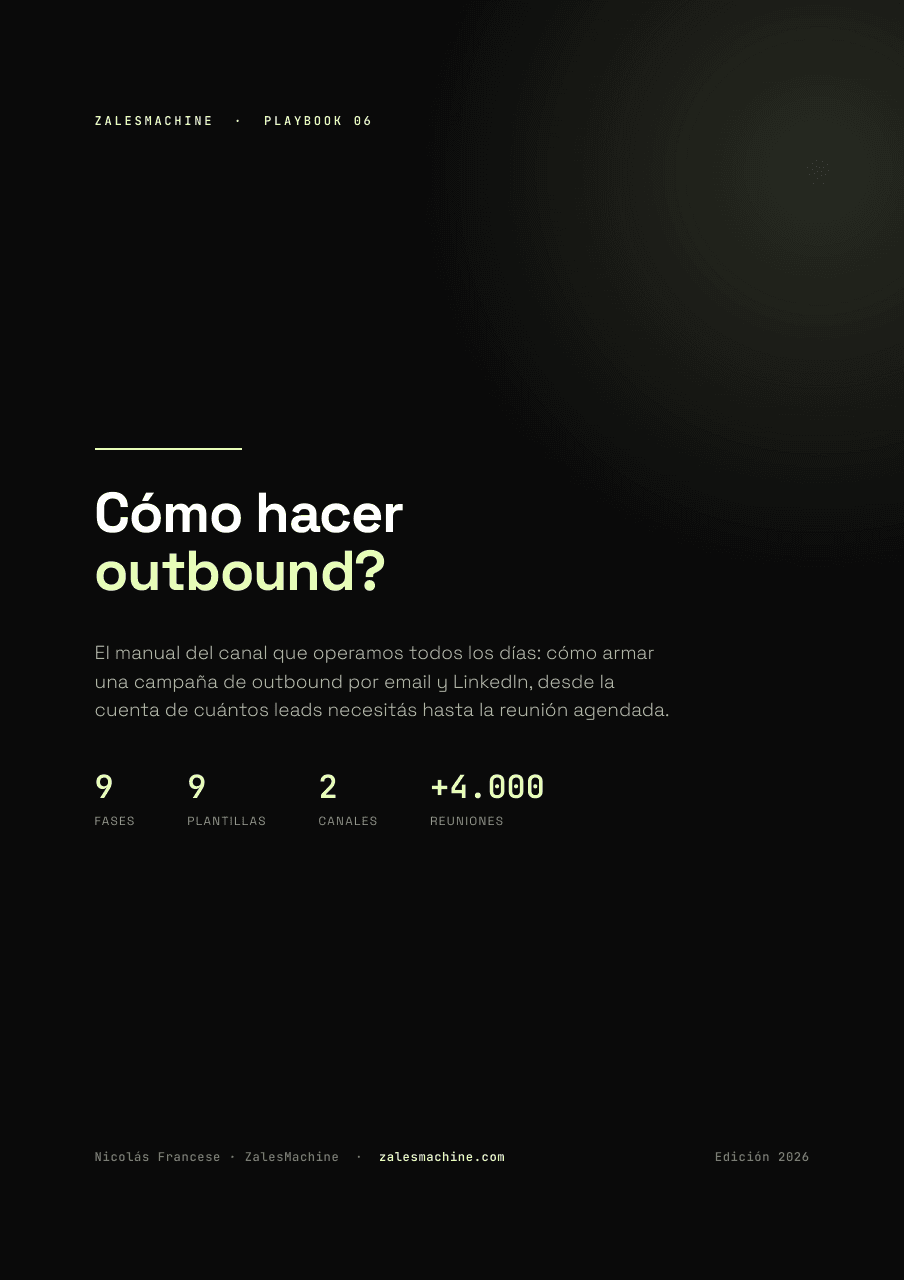
9
phases
9
templates
2
channels
4,000+
meetings
You sent a thousand emails. Four replied, and two were out-of-office.
So you rewrote the message. New subject line, new opening, new close. And the rate stayed the same.
When a campaign gets no replies it can be one of three things that look the same from the outside: the domain is burned and your emails land in spam, the list has the wrong people, or the message doesn't work. The first two give no warning, so the message takes the blame.
And if you sent from your company domain, your whole team's invoices and proposals may be starting to land in spam along with your cold emails.
In most of the cases we saw, the problem was upstream of the message. That is why in this playbook the copy only shows up in phase 6.
It starts with the math almost nobody does before starting.
The manual for the channel we run every day: more than 4,000 meetings booked for more than 50 B2B companies.
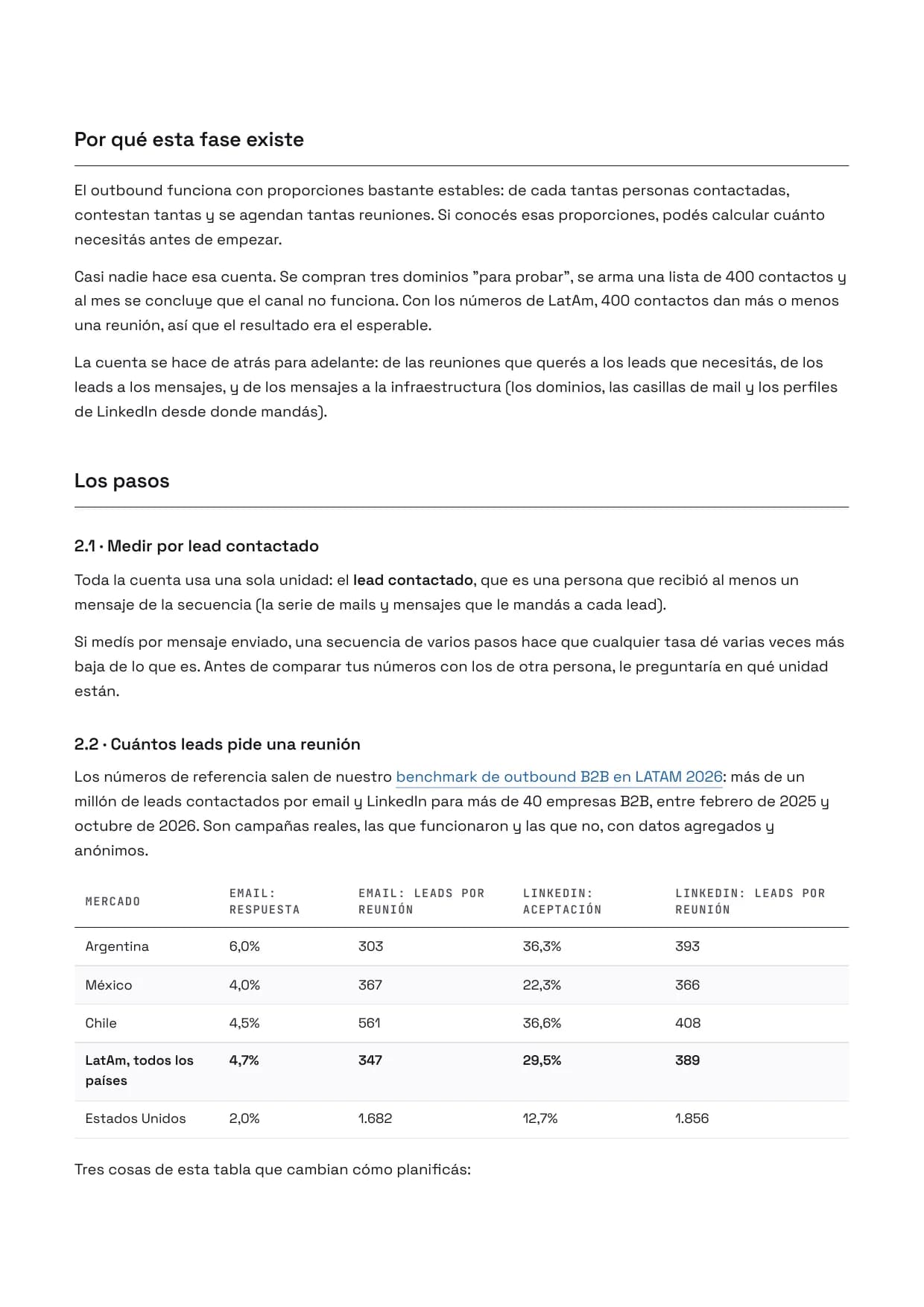
In our published benchmark, one email meeting in LatAm takes reaching 347 people. Ten meetings a month is about 3,500 people and about 16 domains. In the United States, 4.8 times more.
If your whole market is 3,000 people, you want to know before you buy the first domain.
The math
What you do in each of the 9 phases.
You buy the domains when phase 2 is done, and warm-up runs while you work through phases 4 to 6. In 3 to 4 weeks the campaign is sending.
- 1
Context and offer
2 to 3 days
The campaign sheet: segments, value proposition per segment, offer and qualified meeting.
- 2
The volume math
Half a day
How many leads, messages, inboxes and profiles your meeting goal takes, and what it costs per month.
- 3
Sending infrastructure
1 day, plus 3 to 4 weeks of waiting
Secondary domains and inboxes authenticated and warming up, with stop thresholds.
- 4
The list
1 week
A qualified list, with role, persona, validated email, blacklist checked and spend logged.
- 5
Signals and priority
2 days
The list ordered by who has the most reasons to reply today.
- 6
Copy and sequence
3 to 4 days
One sequence per segment, with variables and fallbacks or written per lead with review, and its two-channel calendar.
- 7
Pre-launch check and launch
1 day
Nine checks with a verdict, and the first five leads read one by one.
- 8
Replies
ongoing
The reply workflow: classification, response times, owner and hand-off between channels.
- 9
Measure and learn
1 hour a week
The weekly dashboard and what carries over to the next campaign.
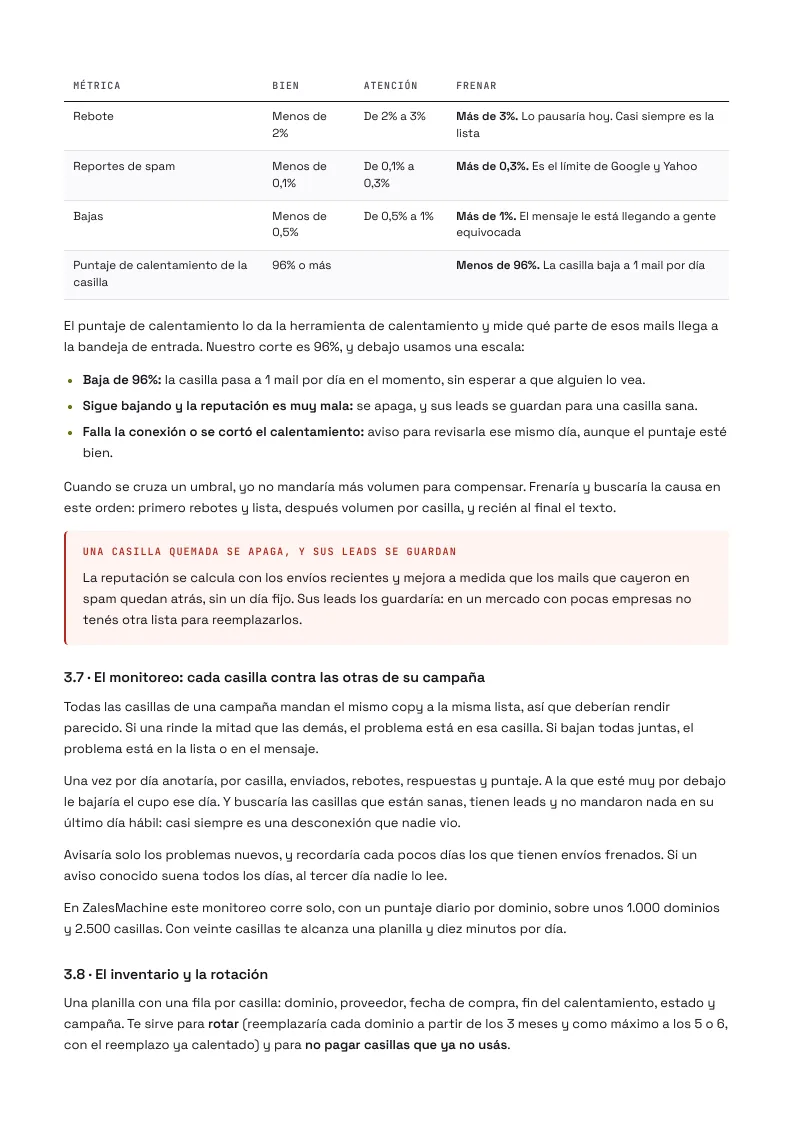
Read a page before you buy.
Our favorite page, in full. If it helps you, the rest is like this.
Free, no email needed
How many leads one meeting takes, country by country.
From phase 2: the ratios from our benchmark of more than a million leads, by email and by LinkedIn. With that table you work out how many leads, domains and inboxes you need before buying anything.
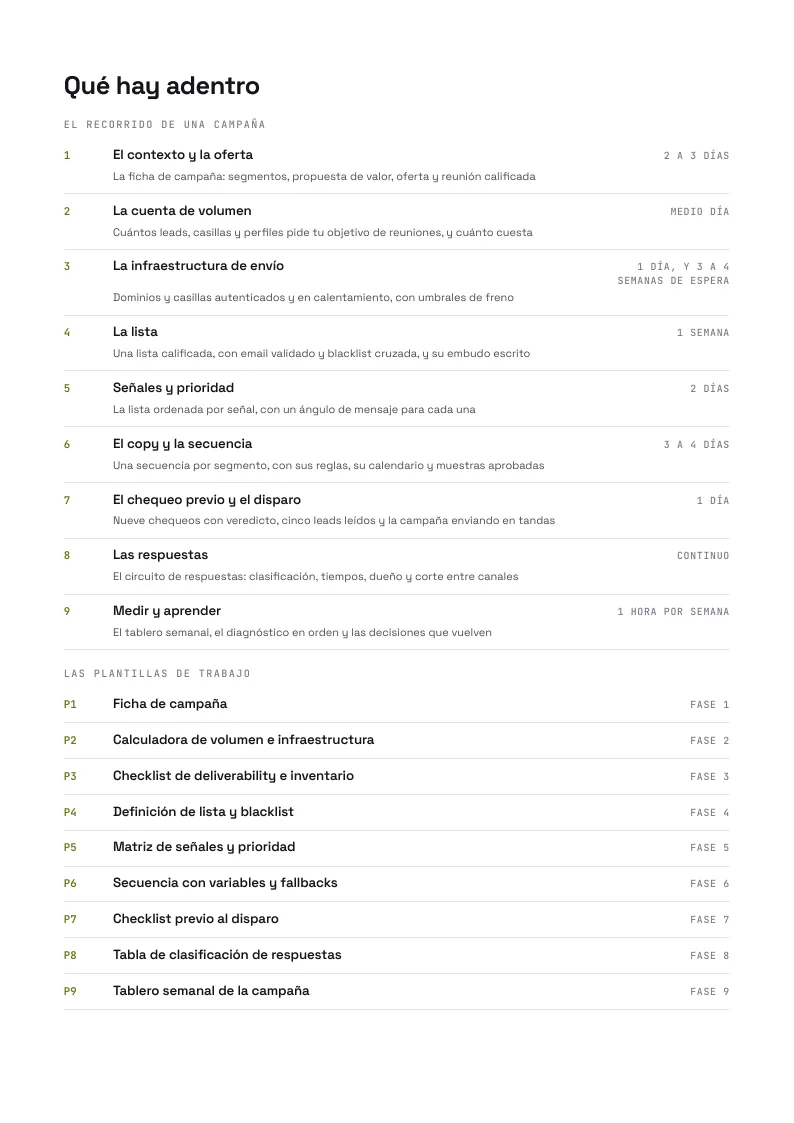
The playbook and 9 working templates.
The 9-phase playbook
With the deliverable, the time and the documented mistakes of each phase.
Campaign sheet
Segments, value proposition per segment, offer and qualified meeting.
Volume and infrastructure calculator
From meetings to leads, domains, inboxes, profiles and monthly cost.
Deliverability and inventory checklist
Per-domain setup, stop thresholds, daily per-inbox check and rotation.
List and blacklist definition
The exclusion layers, the four layers of job titles and the contact search with its spend cap.
Signals and priority matrix
Which signals, with what window, what level and what message angle.
Sequence with variables and fallbacks
The first email in five parts, the variables or the brief and reviewer, and the two-channel calendar.
Pre-launch checklist
The nine checks, the rule of five, the premortem and the batches.
Reply classification table
Eleven categories with what to do and how fast, objections and hand-off between channels.
Weekly campaign dashboard
Metrics per contacted lead, diagnosis in order and what the people who booked have in common.
Access to the Slack community
Where we are, along with everyone else putting it into practice.
Who it's for.
It's for you if
- You've decided to do outbound over email and LinkedIn and run it with your own team.
- You're a founder about to send your first campaign and you don't want to burn your company domain doing it.
- You're an SDR or in growth and inherited a sending tool, a list and no instructions.
- You're in RevOps and have to set up the infrastructure and the reply workflow so others can prospect.
- You already send cold email and don't know whether what's failing is the domain, the list or the message.
It's not for you if
- Your business is B2C. You sell to people, not companies. The whole method assumes you sell to other companies, where someone in a role makes the call.
- Your price point is low and you sell without meetings. The phase 2 math won't add up.
- You want to send a lot without filtering who to. Every step is designed to send less, to the right people.
- You don't know who you sell to yet. Without a defined ideal customer there's no list to build: start with playbook 02 or 03.
- You want someone to run the channel for you. This playbook is for doing it with your team.
- You don't read Spanish. The PDF and the templates are in Spanish.
You won't find anything made up with AI.
The numbers from a real operation, including what went wrong.
The channel we run every day
More than 4,000 meetings booked for more than 50 B2B companies, such as Mendel (712+ meetings), Tapi (290 meetings with decision makers in Mexico) and IntraMed (214+). The cases are published on the site, one by one.
The channel numbers, published
A benchmark of more than a million leads contacted for more than 40 companies: 4.7% reply by email and one meeting gets booked every 347 leads. On LinkedIn, 29.5% accept the invitation.
Rules that come from our own mistakes
The badly loaded field that ended up inside an email, the blacklist that missed a customer, the burned inbox that kept sending for two weeks. Every phase ends with the table of mistakes made there.
The guarantee
If it doesn't add value, we refund your money.
Valid for every playbook, for 7 days from purchase. Email us and we refund the USD 29.
What to know before you buy.
Is it in English?
No. The PDF and the templates are in Spanish. If you read Spanish, the method is the same one we use with our clients.
Does it work if I've never sent a campaign?
Yes. It's written in the order a campaign is built, from scratch.
What if I'm already sending and nobody replies?
It works for that too. Phase 9 has the order to check things in (reputation, list, segmentation, variables and only at the end the copy), and phase 3 shows you how to tell a burned domain from a bad list.
Do I need paid tools?
Yes: domains and inboxes, a sending tool, contact data and validation. Phase 2 gives you the estimated monthly cost for your meeting goal before you buy anything.
Do I have to use Clay?
No. Clay is handy for building the list, and everything here can be done with spreadsheets, each provider's exports and the sending tool. If you want to use it, that's what playbook 04 is for.
Does it work outside LatAm?
Yes. The reference numbers include the United States, which takes 4.8 times more volume. The only regional piece is WhatsApp as a second touch, and it is marked as a LatAm practice.
How long does it take?
3 to 4 weeks until the first send. Most of it is domain warm-up, which runs on its own while you work on the other phases.
What is the Slack community?
Your purchase gets you into the Slack where we are, along with everyone else applying the playbooks. You ask questions, show what you built and see what others build.
Do the math today, before you send the first email
How many leads, inboxes and domains your meeting goal takes. It takes twenty minutes and tells you what to buy.