Customers for your B2B agency or service company
How to get customers for your B2B service: an offer people can actually buy, referrals asked for with a method, one channel run for three months, and a proposal that takes the call to a signature.
Playbook 03 · PDF · Spanish only · one-time payment
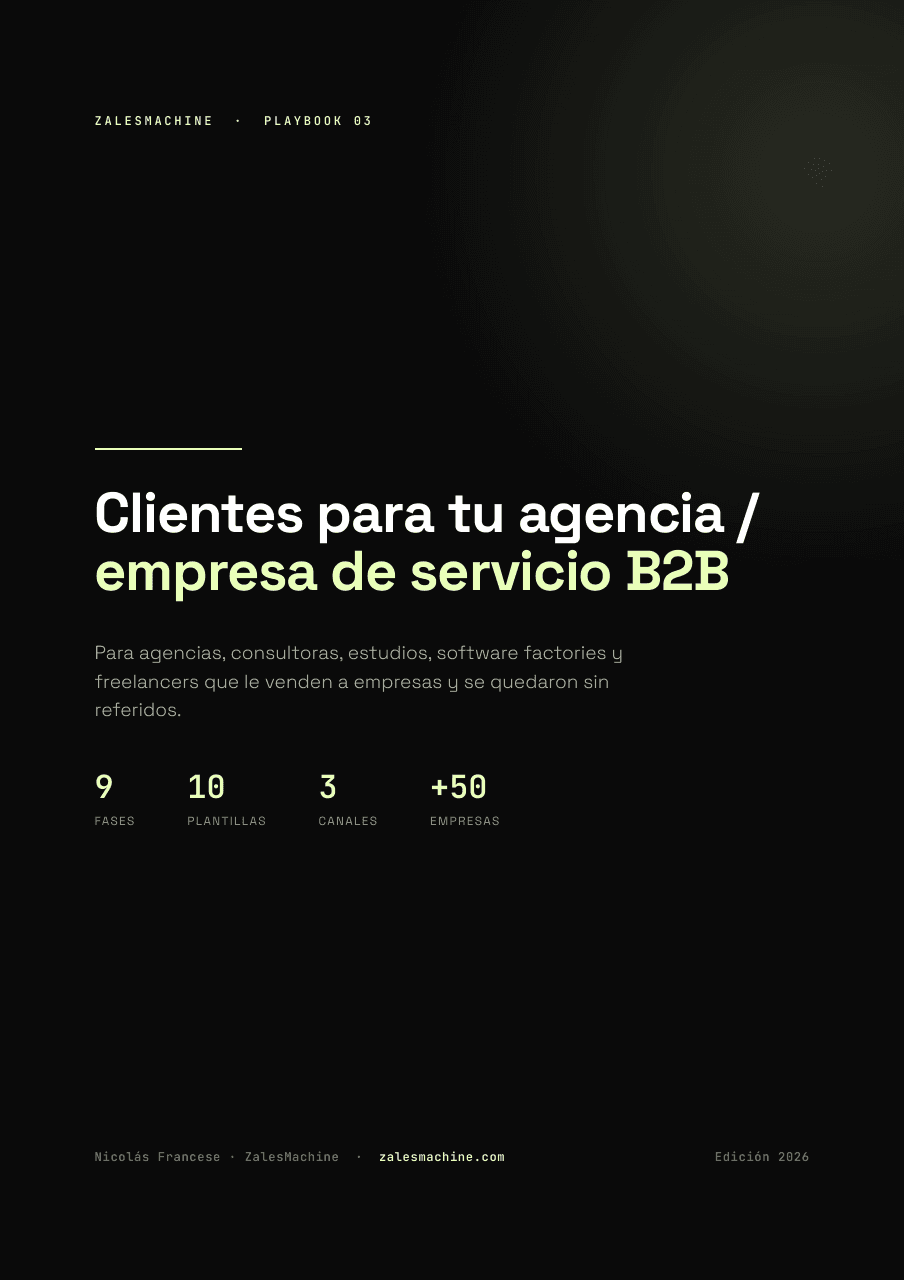
9
phases
10
templates
3
channels
50+
companies
Your customers renew and refer you. And this month nobody came in.
You didn't do anything different. Nobody happened to mention you in a meeting, and you have no way to make that happen.
Try it now: write down your last five customers and where each one came from. If four came through the same person, your company depends on that person remembering you.
And when you go out looking, your messages open with "we are an agency that does...", the call ends in "send me a proposal", you build it from scratch with a price you made up that afternoon, and they say "I'll look at it and get back to you", and they don't.
Almost always the problem is that you're selling your category, without an offer anyone can buy.
A service doesn't show on a screen. It sells with three pieces.
ZalesMachine is a service company too, and we sell ourselves with what is in this playbook: an offer with a published price, a discovery call and a proposal with a guarantee.
Almost everything written about getting B2B customers is built for software: a demo, a free trial, a price on the website. A service has none of that.
It sells with an offer (what you deliver, how you charge, which plan people start on and what happens if it falls short), with your referrals and one channel run for three months with the math done on your margin, and with a nine-section proposal that goes out within 24 hours.
The central piece is the offer, and almost nobody teaches it, because teaching it means showing your own. Here is ours, with the prices we publish.
The math
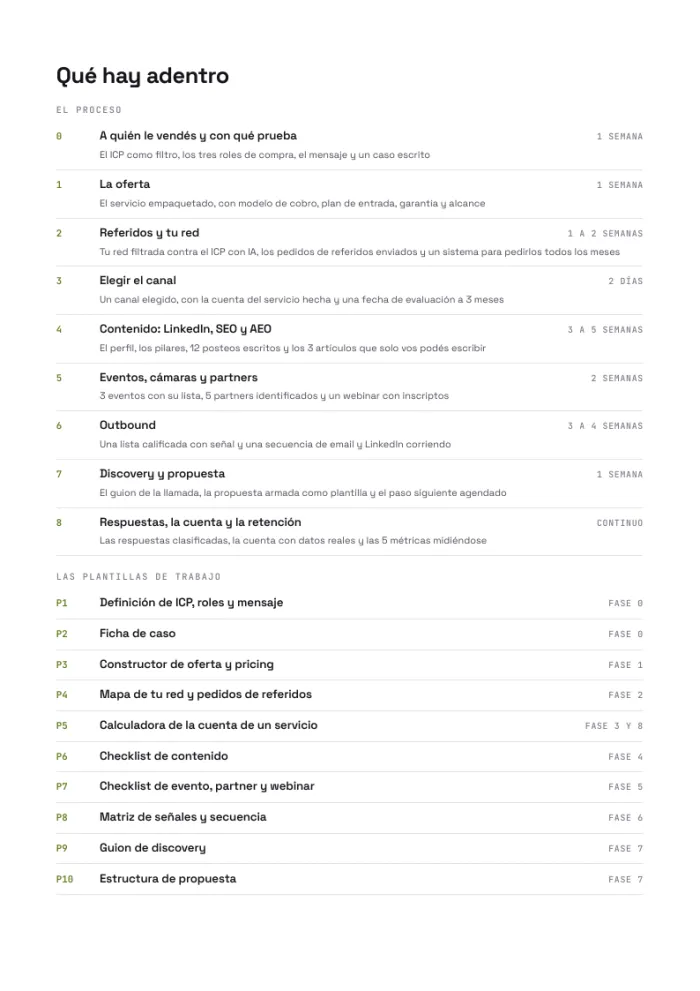
What you do in each of the 9 phases.
Phases 0, 1, 2, 3, 7 and 8 are for everyone. Of phases 4 to 6 you do one: the one for the channel you picked in phase 3.
- 0
Who you sell to and with what proof
1 week
The ICP as a filter, the three buying roles, the message and a written case.
- 1
The offer
1 week
Your service packaged: pricing model, entry plan, guarantee and scope.
- 2
Referrals and your network
1 to 2 weeks
Your network filtered against the ICP with AI, the referral asks sent and a system to ask every month.
- 3
Choosing the channel
2 days
One channel chosen, with the service math done and an evaluation date.
- 4
Content: LinkedIn, SEO and AEO
3 to 5 weeks
Profile, pillars, 12 posts and the 3 articles only you can write.
- 5
Events, trade associations and partners
2 weeks
3 events with their list, 5 partners identified and a webinar with sign-ups.
- 6
Outbound
3 to 4 weeks
A qualified list with signals and a sequence running.
- 7
Discovery and proposal
1 week
The call script, the proposal built and the next step booked.
- 8
Replies, the math and retention
ongoing
Replies sorted, the math with real data and the 5 metrics.
Read a page before you buy.
Our favorite page, in full. If it helps you, the rest is like this.
Free, no email needed
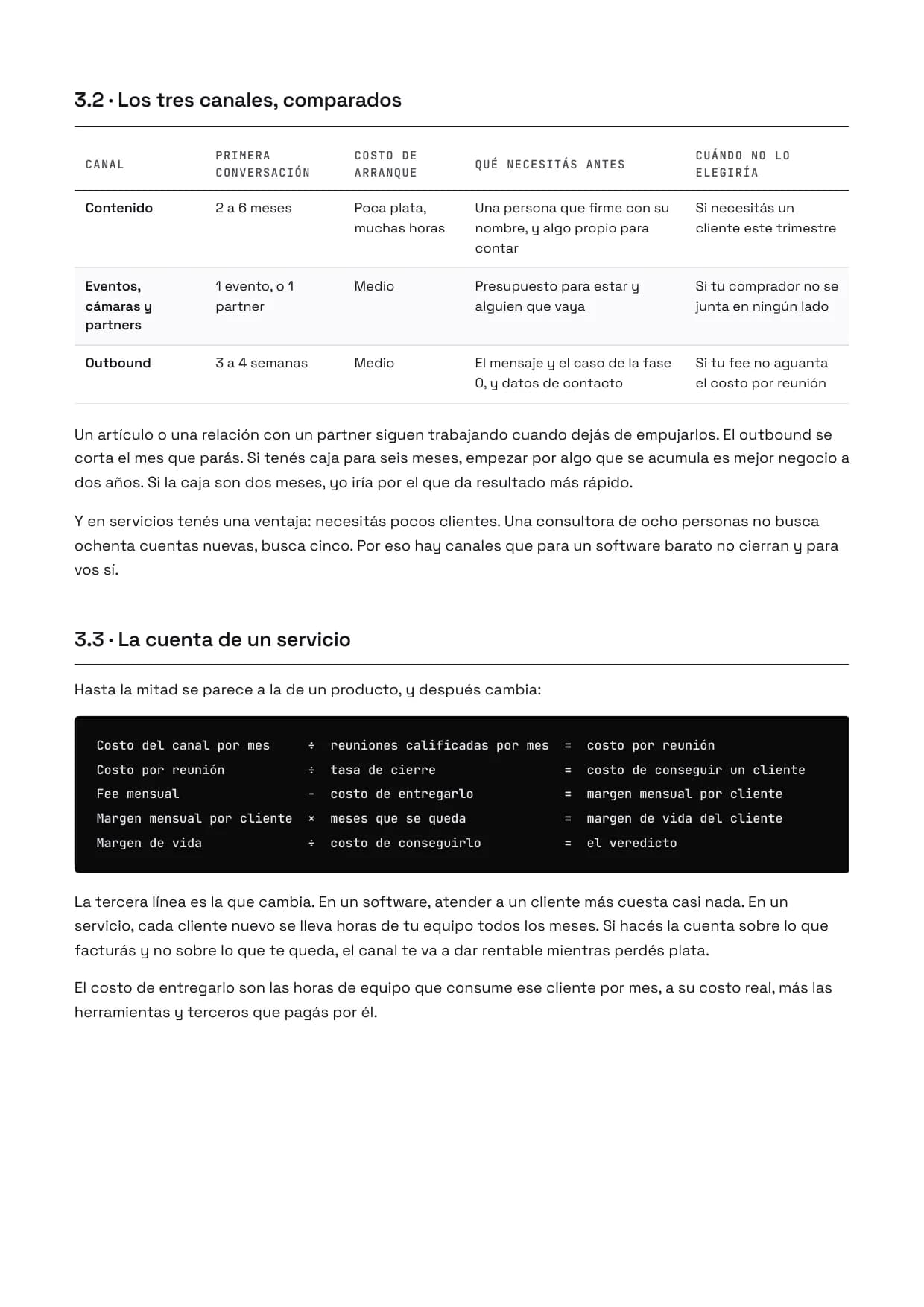
The three channels, compared, and the math of a service.
From phase 3: how long each channel takes to deliver a first conversation, what it costs to get started and when it isn't worth it. Below it, the math that tells you whether a channel works on your margin.
The playbook and 10 working templates.
The 9-phase playbook
With the deliverable, the time and the documented mistakes of each phase.
ICP, roles and message definition
It starts with your last five customers: where each came from and what each left you.
Case sheet
How to write a case with few customers, in three lengths.
Offer and pricing builder
The six decisions, the floor and ceiling of the price, and the guarantee clause.
Network map and referral asks
The messages, the export from each network, the AI filter and the introductions log.
Service math calculator
Margin, capacity, cash and verdict.
Content checklist
The profile, the 12 posts and the three articles.
Event, partner and webinar checklist
The semester's events and the partner agreement in five conditions.
Signals and sequence matrix
The math worked backward, the order of the list and the infrastructure.
Discovery script
The questions for each stretch, the data you ask for and the close with price and date.
Proposal structure
The nine sections, the table against doing it in-house and the four follow-up messages.
Access to the Slack community
Where we are, along with everyone else putting it into practice.
Who it's for.
It's for you if
- You sell a service to companies (agency, consultancy, studio, software factory or freelance) and today you live off referrals.
- You have customers and a working operation, but you can't say where the next customer will come from.
- You quote every job from scratch and every sale feels like the first one.
It's not for you if
- Your business is B2C. You sell to people, not companies. The whole method assumes you sell to other companies.
- You sell software or a SaaS product. That is what playbook 02, "I built my software. Now what?", is for.
- You haven't delivered your service even once. Without a customer served you have no case to show, and a service sells on cases.
- You want someone else to close your sales. This is about getting and qualifying conversations; you run the call and the proposal.
- You don't read Spanish. The PDF and the templates are in Spanish.
You won't find anything made up with AI.
The numbers from a real operation, including what went wrong.
This is how we sell ourselves
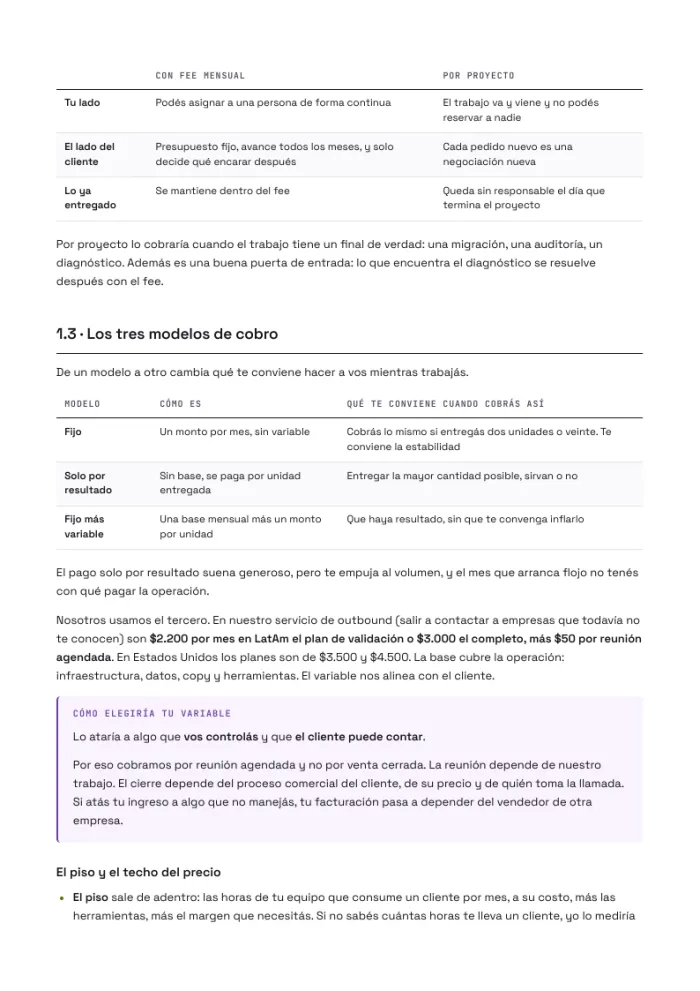
What you read in phase 1 is our real offer: in LatAm, $2,200 a month for the validation plan and $3,000 for the full one, plus $50 per booked meeting. And a guarantee in the contract: if we miss the target, we keep working without charging until we hit it.
We do it every day
We book qualified meetings for more than 50 B2B companies, more than 4,000 so far. The reference numbers come from a published benchmark of more than a million leads contacted.
Service cases, with names
Orka, a paid media and UGC agency: more than USD 10,000 in MRR and more than 294 meetings. BrandSide, a design agency: a branding deal of more than USD 7,000 in one month. Making Sense, a software factory: more than 40 meetings in the United States.
The guarantee
If it doesn't add value, we refund your money.
Valid for every playbook, for 7 days from purchase. Email us and we refund the USD 29.
What to know before you buy.
Is it in English?
No. The PDF and the templates are in Spanish. If you read Spanish, the method is the same one we use to sell our own service.
I'm a freelancer with no team. Does it work for me?
Yes. The math in phase 3 is built for when the person selling is the same one delivering, and your hours count as a cost.
I don't have a single customer yet. Does it work for me?
Not entirely. Without delivered work you have no case, and phase 0 needs one. Land the first one however you can, then come back.
I sell software. Is it for me?
No. For software or a SaaS product there is playbook 02, "I built my software. Now what?". This one assumes you sell a service and have nothing to show on a screen.
How do I use AI with my network? Do I have to scrape?
No. Phase 2 shows you how to download your contacts with the official exports from LinkedIn, Instagram and your phone's address book, filter them against your ICP with a model, and write to them by hand. Scraping breaks the terms of all three networks.
Do I need paid tools?
For phases 0, 1, 2, 3 and 7, none. For outbound, yes: as a reference, between $250 and $400 a month for 5 meetings a month.
What is the Slack community?
Your purchase gets you into the Slack where we are, along with everyone else applying the playbooks. You ask questions, show what you built and see what others build.
You can wait for the next referral, or you can go ask for it
The offer, the script and the proposal get written once, and you stop reinventing them on every sale.